



THE DIFFICULTY OF ENFORCING JUDGMENTS
Michael Redman on the challenges of enforcing judgments
Michael Redman of Burford Capital has written an interesting article on the challenges of enforcing judgments, which was published in the October 2015 issue of Litigation Funding (click here).
As far as the Dutch Caribbean (Aruba, Bonaire, Curaçao, St. Maarten, St. Eustatius and Saba) is concerned, the enforcement of a judgment rendered by for instance an English court will be subject to the provisions of the Convention between the Kingdom of the Netherlands and the United Kingdom and Northern Ireland regarding Mutual Recognition and Enforcement of Judgments in …
Read the rest »


ATTACHMENTS UNDER THE LAWS OF CURACAO (part II)
Defendant has to show that the claim is invalid
Article 705, Paragraph 2 of the Curaçao Code of Civil Procedure states that the lifting of an attachment may be ordered if it appears summarily that the claim is invalid.
According to existing case law of the Dutch Supreme Court (see for instance Supreme Court dd June 14, 1996, NJ (Dutch Law Reports) 1997, 481), this means that the plaintiff (i.e. the party requesting the attachment be lifted in summary proceedings), with due regard for the limitations of summary proceedings, should establish a prima facie case (aannemelijk maken) that the alleged …
Read the rest »
ATTACHMENTS UNDER THE LAWS OF CURACAO (part I)
Freezing assets is rather easy
Under Curaçao law any party with a prima facie claim may file a petition for a court order granting an attachment, which petitions are generally granted, solely based on the allegations in the petition. It is not required, under Curaçao law, that the litigant needs to demonstrate that, in absence of an attachment, there is a risk that the defendant would have insufficient assets to pay a judgment, as a threat of evading a judgment (by moving assets etc.) does exist.
Only with respect to some types of assets, such as registered shares and other …
Read the rest »
RESTRUCTURING, REFINANCING AND CREDITOR PROTECTION
Diligence is required
Especially in these times of global economic and financial turmoil, an international group of companies (or part thereof) might want to consider restructuring and refinancing its operations or may be already in the process of doing so. When considering or carrying out such plans, careful thought must be given to potential (legal) risks involved. For instance, in many jurisdictions specific statutory provisions exist regarding fraudulent preference actions, i.e. actions that prejudice (specific) creditors. Such provisions often also apply in full with respect to (individual companies belonging to) a group of companies, and should not be overlooked in …
Read the rest »
OPPORTUNITIES TO MEET ME
Amsterdam, The Hague & Vienna
I am going to attend the following conferences:
I hope to meet many colleagues and others from all over the world.
Karel Frielink (Attorney/Lawyer, Partner)
(17 September 2015)
.
FRAUD (part II)
Legal forms of fraud
The person who forges a diploma, agreement or identity document is guilty of a criminal offence. Although the concept of ‘fraud’ is only mentioned in relation to human trade in the Criminal Code of Curaçao, there are various offences which can have a relationship with fraud in the sense meant herein: forgery, embezzlement, swindle, (fraudulent) bankruptcy and bribery.
In civil-law relationships the doctrines such as breach of contract, wrongful act, misleading advertisement, error and deception come to mind. In addition, there are lots of other Acts with special provisions such as tax law. I will pass …
Read the rest »
FRAUD (part I)
Curaçao
Fraud is an everyday occurrence. It is of all times, and a phenomenon that happens in every country. In discussions about fraud (and corruption) in Curaçao you regularly see that people refer to other countries, in particular to the Netherlands, to downplay this phenomenon here somewhat. The small number of criminal prosecutions and convictions are often mentioned. In this connection it is often said that they are of ‘a political nature’. Sometimes it is even alleged that someone’s integrity can only be discussed when there is a criminal conviction. We can delude ourselves a lot!
In the event of …
Read the rest »
NO DERIVATIVE ACTION IN CURACAO
A claim based on tort is possible though
Curaçao corporate law does not provide for any derivative suit mechanism (and neither do the laws of Aruba, St. Maarten and the BES-islands). This matter was first decided in the cases of Poot v. ABP, Hoge Raad (Dutch Supreme Court) 2 December 1994, NJ 1995, 288, and Constance et al. v. Noro et al., Gemeenschappelijk Hof van Justitie van de Nederlandse Antillen en Aruba (Joint Court of Appeal of the Netherlands Antilles and Aruba) 13 December 1994, SJD 1994, 498.
However, a shareholder suffering derivative damage may commence proceedings against, for instance, …
Read the rest »
CURACAO NORTH SEA JAZZ FESTIVAL 2015
CNSJ – The marquee musical event of the Caribbean
Excellence, in both law and music,
is the art of playing with the Rules
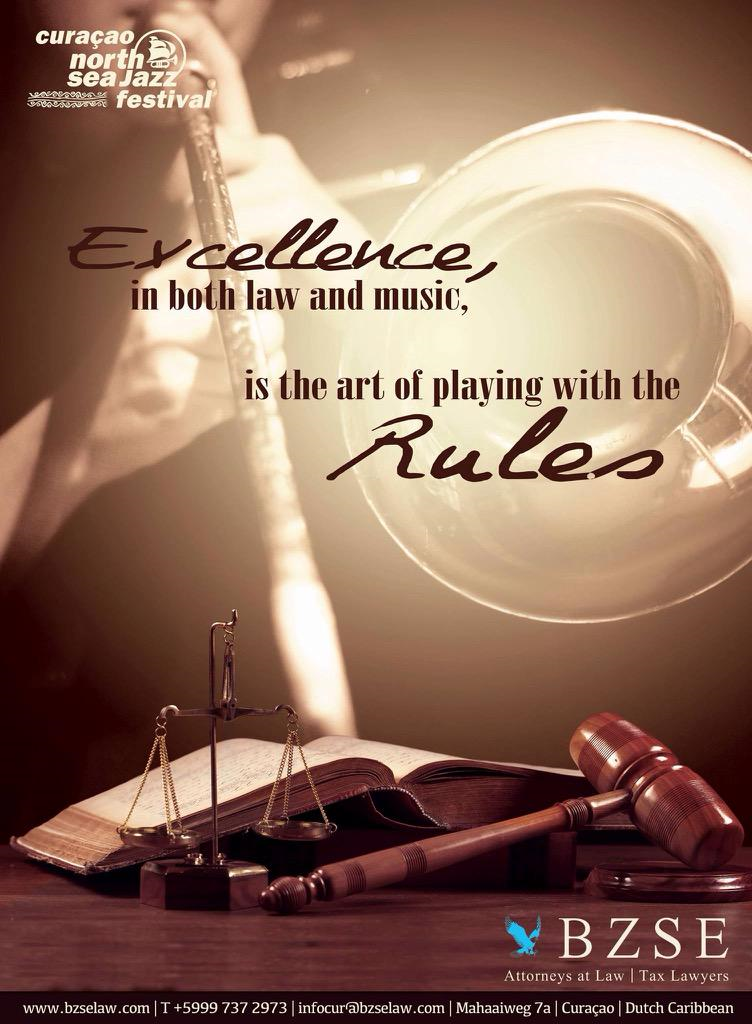
Let’s crack some ‘nuts’ now!
BZSE Attorneys at Law / Tax Lawyers / Mediation – Dutch Caribbean
(27 August 2015)
.
DUTIES OF A MANAGING DIRECTOR OF A DUTCH CARIBBEAN NV OR BV
Acting in the best interests of the company
Although not explicitly provided for in Book 2 of the Civil Codes of Curacao, St. Maarten and the BES-islands (Bonaire, St. Eustatius and Saba) (“CC”), it is considered a general rule of corporate law that the management board (a.k.a. board of directors) must act in the best interests of the company (an NV or BV) in the performance of its duties, even when acting on instructions from others (e.g. shareholders). This includes the interests of the shareholders, the employees and, according to most legal writers, the creditors of the company.
The management …
Read the rest »
THE CONCEPT OF LIABILITY IN THE DUTCH CARIBBEAN
A three-part distinction
With regard to liability a three-part distinction can be made. The first distinction relates to the basis of the liability: liability pursuant to a contractual relationship (the attributable failure in this respect) and liability pursuant to a wrongful act.
Another distinction relates to the personal liability (thus for the party’s own actions or omissions) and vicarious and/or strict liability: liability for or the acts and omissions of others (vicarious liability) or liability for certain things that happen (strict liability).
For example, employers can be held vicariously liable for certain actions of their employees. According to the Civil …
Read the rest »
WETTEN EN WETGEVINGSPROCES
Tijd voor verbeteringen?
Wetten zorgen in onze samenleving voor sturing en ordening. Ze bepalen welke bevoegdheden en verplichtingen we hebben. Ze verschaffen ons vrijheid en stellen tegelijkertijd grenzen daaraan. Wetten zijn er – zogezegd – in alle(rlei) soorten en maten.
Al eeuwen wordt er gediscussieerd over wetten, breder: over het recht, en de vraag naar het gezag daarvan. Waarom moeten we ons aan wetten houden? Waarop zijn wetten (en de daarin vastgelegde normen) gebaseerd? Ik verwijs naar een interessante studie van Shirley Robin Letwin, On the History of the Idea of Law (Cambridge University Press; reprinted 2007). En voor wie …
Read the rest »